Yardage vs. a laser rangefinder
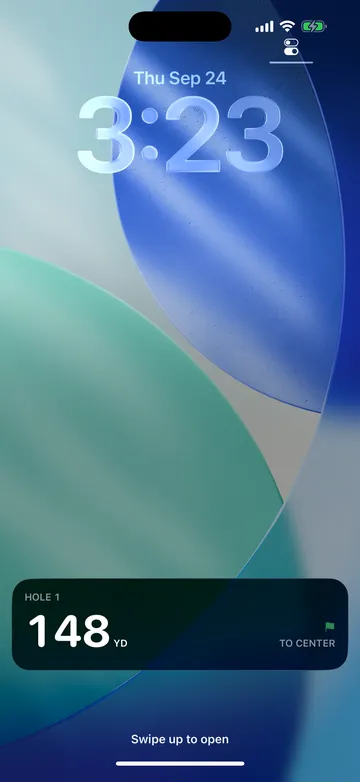
You don’t need a laser to know you’re 148 out.
A laser gives you the flag to the yard, if you can see it and hold it steady. Your phone already knows the distance to the center of the green, with nothing to aim, and it can put that number on your Lock Screen. For most golfers on most shots, that’s the better number. Here’s the case, including the parts where the laser wins.
Get the free betaiPhone only. Free during the TestFlight beta. On the App Store: first round free, then $1.99 a round, $5.99 a month, or $29.99 a year.
The short version
Quick context if you're new: Yardage is an iPhone app that shows one number, the GPS distance to the center of the green, and puts it on the Lock Screen. Here's how that stacks up against a laser. (Weighing a GPS watch or a handheld too? The four-way comparison covers those.)
| What matters | Laser rangefinder | Yardage |
|---|---|---|
| What it measures | Line-of-sight distance to whatever you aim at, usually the flag | GPS distance to the mapped center of the green |
| Precision | Typically about a yard, with a steady hand and a clear line of sight | Phone GPS is typically within about 5 m (16 ft) under open sky, per GPS.gov; worse near trees and buildings |
| Aiming | Required. Find the flag, steady the reticle, click, read, sometimes click again | None. The number is there when you look |
| Blind shots, doglegs, greens you can't see | No target, no number | Same number as always |
| Where it is during the round | In the bag, in a case, on a strap | In your pocket, on the Lock Screen, in the Dynamic Island |
| Cost | Roughly $150 to $500 and up | First round free, then $1.99 a round, $5.99 a month, or $29.99 a year |
| Rules of Golf | Allowed unless a Local Rule prohibits distance-measuring devices; slope must be off | Allowed unless a Local Rule prohibits distance-measuring devices; shows distance only |
| Fog, drizzle, dusk | Has to see the target | GPS doesn't need to see anything |
| Battery | Its own | Uses your phone's battery during the round |
| Courses | Any target, anywhere | 14,987 mapped US courses. Not mapped, no number |
| Pin-hunting, lay-ups to a specific spot | Its job | Not what it does |
Where the laser wins
We make the app, so weigh this however you like. A laser is the better tool when:
- You're actually going at the pin. A tucked flag on a green 35 yards deep can sit 15 yards from the middle. If you hit it close on purpose, the exact number is worth having.
- You need a distance to something that isn't a green. A bunker lip on a lay-up, a tree to carry, the far edge of a hazard on a par 5. Yardage has one target: the center of the green.
- Tournament golf where you want the pin. Distance-measuring devices are allowed under the Rules of Golf unless a Local Rule says otherwise. When they're allowed, competitors want the pin number, and the laser has it (with slope switched off).
- Your course isn't mapped. A laser doesn't care. Yardage needs the course in its catalog: 14,987 US courses today. Check yours further down.
If that's you, keep the laser. Some golfers use both: the phone for the number on every shot, the laser for the few where the pin matters.
Why the middle is the number that matters
Be honest about your last ten 7-irons. Not the good one. All ten. If they'd fit inside a circle 20 yards across on a decent day, a yard-perfect reading to the flag is precision you can't spend. The club you pick for 148 to the middle is the club you pick for 146 to the pin.
The research points the same way. Mark Broadie's strokes-gained analysis (Every Shot Counts, 2014) found that the long game, meaning shots from outside roughly 100 yards, explains about two-thirds of the scoring difference between amateurs at different levels, with approach shots as the biggest single piece. Strokes go missing when approach shots miss greens: short in front, short-sided in a bunker, long into trouble. Playing to the middle with the right club is the plainest fix there is, and it starts with knowing the distance to the middle on every shot, not just the ones where you bothered to get the laser out.
Then there's the flag itself. It moves every morning. The center of a green doesn't. A number tied to the middle is the same on Tuesday as on Saturday, which is the number you can learn a course by.

The laser you leave in the bag
Every laser owner knows the routine. Walk to the ball. Decide whether this shot is worth the trip back to the bag. Unzip the case, find the flag, hold steady, click. Get a reading off the tree behind the green. Click again. Put it away. Then pick a club. On a windy day the reticle wanders, and on a par 3 with a foursome waiting behind you the whole thing is a small social event.
So the laser stays in the bag for the "close enough" shots, which is most of them. The phone in your pocket doesn't have that problem. The number is on the Lock Screen before you've finished walking to the ball. Pull it out, glance, hit.
The cost math
A laser rangefinder runs roughly $150 to $500 and up, once, plus a battery now and then, plus whatever it costs the day it bounces out of the cart. Yardage: the first round is free. After that, a single round is $1.99 for 8 hours of access, unlimited rounds are $5.99 a month, or $29.99 a year. Everything goes through Apple. Cancel in your iPhone's Subscriptions screen; there's no account with us.
Which is cheaper depends on how much you play and how long you keep gadgets. Put in your own numbers: rangefinder vs. app cost calculator. It shows the break-even in rounds. Plan details are on the pricing page.
Accuracy, honestly
GPS.gov, the U.S. government's site about GPS, says GPS-enabled smartphones are typically accurate to within a 4.9 m (16 ft) radius under open sky, and that accuracy worsens near buildings, bridges and trees. Sixteen feet is about five yards. That's the same for every phone GPS app; nobody's software makes the satellites better.
What Yardage does about it: it requires Precise Location, it tells you on screen when GPS quality is reduced or the number is stale, and it shows a number only when it has one. Walking a few steps out from under the trees usually clears a poor signal. And because the target is the center of the green, five yards of uncertainty rarely changes the club. The green is bigger than the error.
A laser, aimed well, is more precise than that. We're not going to argue otherwise. We're arguing that for most golfers, the number to the middle of the green, available on every shot, is the more useful thing to own. The long version, covering phones, watches and handhelds: how accurate golf GPS is.
Tournaments and the Rules of Golf
Under the Rules of Golf (Rule 4.3a), a player may use a device to measure distance during a round unless the Committee has adopted a Local Rule prohibiting it (Model Local Rule G-5). That applies to lasers, GPS watches and phone apps alike. What the Rules don't allow, even where devices are permitted, is using one to measure elevation changes or to have it interpret the information for you, such as recommending a club. Yardage shows distance only, so there's nothing to switch off. Read the Local Rules sheet or ask the committee before your event; the USGA and R&A publish the specifics, and we've written up what the Rules say about rangefinders and GPS in plain words.
What Yardage is not
- Not a pin distance. Center of the green only.
- Not front and back, not hazards, not lay-ups, not scoring, not stats, not club suggestions.
- Not on Android, Apple Watch, or the web. iPhone only.
- Not a laser. If the sections above didn't convince you, buy the laser. We mean that.
Is your course mapped?
14,987 US courses in all 50 states. Search yours.
No match yet. Try a shorter name, the town, or a different spelling. If it really is not here, tell us and we will check it.
Course not listed? Tell us.
Some courses aren't in Yardage yet. Give us the name and town and we'll look.
Questions
Is a golf GPS app as accurate as a laser rangefinder?
No, and we don't claim it is. A laser aimed well is typically accurate to about a yard. GPS.gov says a GPS-enabled smartphone is typically accurate to within a 4.9 m (16 ft) radius under open sky, and worse near buildings and trees. Yardage measures to the center of the green, so a few yards of uncertainty rarely changes the club you pick.
Does Yardage measure to the pin?
No. It shows the GPS distance to the mapped center of the green. Pin positions change daily; the center of the green doesn't. If you need the pin number, a laser is the right tool for that shot.
Can I use Yardage in a tournament?
Under the Rules of Golf, a player may use a device to measure distance unless the Committee has adopted a Local Rule prohibiting it (Rule 4.3a and Model Local Rule G-5). That applies to lasers, GPS watches and phone apps alike. Yardage shows distance only. Check the Local Rules for your event and ask the committee if you're unsure.
What does Yardage cost compared with a rangefinder?
A laser rangefinder runs roughly $150 to $500 and up, once. Yardage's first round is free; after that you pay per round, per month, or per year through Apple, and you can cancel in your iPhone's Subscriptions screen. Current prices are on the pricing page, and the cost calculator shows the break-even for however much you play.
Should I sell my rangefinder?
Not on our account. Keep it for pin-hunting, lay-ups to a specific bunker or tree, and events where you want the pin number. Use the phone for the center-of-green number on every other shot, which for most golfers is most shots.
Does it work without cell service?
Yes, once your course is loaded. The course maps ship inside the app, and GPS doesn't need a data connection.
Does GPS drain the battery?
Any app that uses location during a four-hour round costs some battery. Yardage uses location only during a round you started, and the Lock Screen shows the number so you aren't unlocking the phone on every shot. Start the round charged; if you ride, the cart's USB port helps.
Try the number for a round.
Free during the beta. iPhone only. Keep the laser if you want it; you'll know after nine holes which one you reach for.
Get the free beta